A Year of Library Receipts: My Checkout History as a Map of Every Rabbit Hole
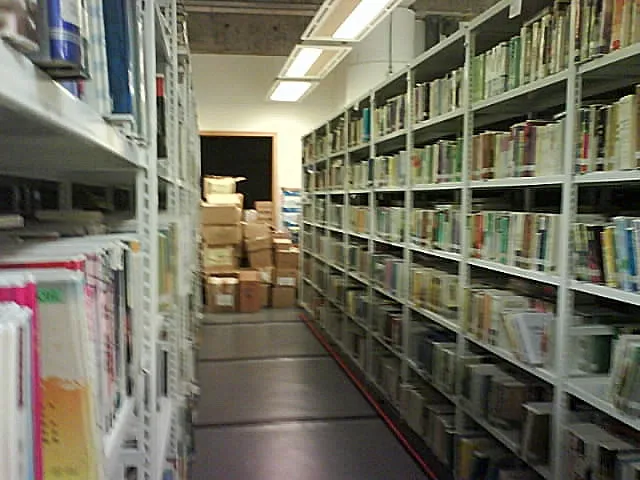
Photo: .mw-parser-output .ubx-floatdefault[dir="ltr"],.mw-parser-output .ubx-floatopposite[dir="rtl"],.mw-parser-output .ubx-floatleft{float:left}.mw-parser-output .ubx-floatdefault[dir="rtl"],.mw-parser-output .ubx-floatopposite[dir="ltr"],.mw-parser-out
The cheapest productivity tool I own is a library card, and it has been recording my process in the background for years without asking permission.
My account has a feature I did not know about until this fall: full checkout history, exportable, going back years. I pulled twelve months of it, printed it at the library for fifteen cents a page, and sat down to read the archaeology of my own curiosity. Here is what a year of holds looks like when you stop treating it as errands and start treating it as a diary.
1. The concrete phase (January–February)
Nine books about concrete. Not architecture — concrete. Board-formed, brutalist, poured-in-place, the whole thing. This started because I saw a photo of the Yale Art Gallery stairwell and lost my mind for six weeks.
Nothing came of the concrete phase. No essay, no project, no post. But I can tell you that I still think about board-formed concrete roughly once a month, and that the phase cost me zero dollars and one very confused librarian.
2. The thing that actually became a project (February–April)
“The Forest Unseen,” a field guide to mosses, two books on lichen, and a seed catalog a friend recommended. Four books, all checked out within eleven days of each other.
That trail went somewhere. It became the newsletter issue I still get the most email about, and it took three months from first checkout to finished piece. This is the longest gap between curiosity and output in my entire history, which is a useful thing to know about myself and slightly depressing to learn from a spreadsheet.
3. The rabbit hole with a body count (May)
Six books on competitive eating. I am not going to explain this. I will only say that it was research for something, that the something is still in a folder, and that the folder is called hot_dog_thing.
There is also a hold on a book about the history of the Coney Island hot dog that I placed in May and that arrived in September, long after I had stopped caring, and that I read anyway in two days.
4. The grief stack (June)
Five memoirs about loss, requested over eight days. I did not have a project in mind. I want to be careful here, because in my experience a stack like this usually means a person is going through something, and I was, and the library was how I did it without telling anyone.
This is the category I would not have predicted in January and the one I feel most strongly about when I look at the printout. Not everything in a creative life is research. Some of it is just reading, and the reading still counts.
5. The typography detour (July–August)
Eleven books about 1970s American signage, letterpress catalogs, and one enormous book about municipal wayfinding that I renewed three times and then lost under my couch.
This one is still alive. The typography trail has produced two things so far and a third that I am pretending is not a project yet. It is also the trail with the most holds — seven of them, back to back, all satisfied within about a week each. When my holds list gets that crowded, it usually means I have already decided to make something and am gathering permission rather than information.
6. The stalls (various)
A book about lighthouse keepers, requested twice, checked out once, never opened.
Three books about productivity, which I read no more than forty pages of, in the way that you watch a cooking show when you are hungry and unwilling to cook.
A book about betting on horse racing, from a weekend when I thought I might write about a racetrack in Saratoga.
Every one of these is a small, harmless, fully refunded failure of curiosity. The library forgave all of it, which is more than I can say for my own browser history.
7. The holds list is the real forecast
Here is the part that surprised me. My checkout history tells me what I have been interested in. My holds list tells me what I am about to make.
Right now there are four books waiting for me: one on tidal pools, one on the history of the American roadside motel, one on a specific variety of apple, and — inexplicably, again — another book about concrete.
I can see the next three months in those four titles. The motel one already has a folder. The tidepool one is a photograph waiting to happen. The apple one is a mystery and I am leaving it alone on purpose.
8. What the library does that my notes app can't
My notes app records what I decided. My browser history records what I clicked in a panic. The library records what I cared enough about to ask a stranger to find for me, and then to wait for, sometimes for months.
Waiting is the whole thing. When you place a hold, you are committing to wanting something in the future. Then it arrives in the future and you find out whether past-you was right.
That is a feedback loop most creatives would pay a subscription for. Mine is free, comes with a building, and nobody in there cares that I have never finished anything on time.
9. The one habit I'm keeping
I now print the year's list every December and read it like a stranger's. Twice, doing this, I have found a hold trail I abandoned that turns out to be worth picking back up — a topic I went four books deep on and then forgot entirely.
That is my whole productivity system. Not a planner. A receipt. The library keeps it for me, and all I have to do is show up and ask.