The Delete Key Is a Curation Tool: Ten Ideas I Finally Let Go
Photo: LSE Library, Public domain, via Wikimedia Commons
I keep a folder called MAYBE. It is not a cute name. It sounds like a shrug with a filing system. Inside were ten ideas I had been carrying for years — a newsletter concept, a zine about road-trip snacks, a half-built course, a title for an essay I never wrote, three sketches of projects that existed mostly as color palettes, and one very earnest spreadsheet labeled “Phase One.”
Last week I opened MAYBE, selected ten files, and hit delete. Not archive. Not move to a hard drive I would forget to plug in. Delete. The little confirmation window popped up, and I sat there like I was about to cancel a flight.
The guilt arrived right on schedule
The first delete felt like breaking a promise to a version of myself who had been very excited in 2019. She had made mood boards. She had told two people about it. She had bought a domain. Who was I to throw her work in the trash?
That is the trick of an unfinished idea: it starts to feel like a debt. You owe it a launch. You owe it the afternoon you said you'd block off. You owe it a explanation for why you stopped. Every time you see the file, you get a little invoice from your past self.
The guilt was not really about the idea. It was about the story I had been telling myself — that a person who keeps every spark is more creative than a person who lets some sparks go out. But keeping a folder full of maybes was not making me more prolific. It was making me tired.
The small ceremony I needed
I am not above a ceremony. I once wrote a fake award acceptance speech for a project that never shipped, so please understand that when I say ceremony, I mean index cards and a candle that smelled like cedar.
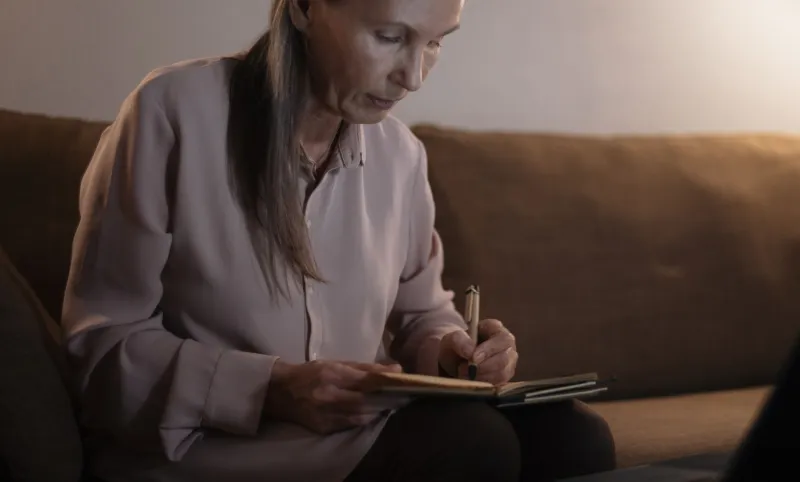
I wrote each idea on its own card. Ten cards. I read them out loud, which felt ridiculous until it didn't. Then I said the same sentence for each one: “This was a good thought. It is not my work anymore.”
That sentence mattered more than the delete button. It let the idea be good without making it my responsibility. Some of those ideas were genuinely clever. One of them I still think about. But clever is not the same as chosen.
After the tenth card, I deleted the folder. Then I closed my laptop and made a sandwich. That was the whole ritual. No lightning bolt. No sudden burst of productivity. Just a quiet kitchen and the faint smell of cedar.
What I learned about keeper versus curator
For years I thought being a creative person meant being a keeper. Keep the notes. Keep the drafts. Keep the what-ifs. Keep the proof that you once had an idea.
But a curator does not keep everything. A curator chooses. A curator walks into the storage room and says, “This is the story. These are the pieces that belong in it.” That is a different job, and it is a harder one, because it requires letting some perfectly good things stay out of the room.
Deleting those ten ideas did not make me less of a maker. It made me a slightly better editor of my own time. I still have plenty of unfinished projects. I still have a folder called MAYBE, because I am not a monk. But it is smaller now, and I trust it more.
The relief came in a weird place: about three days later, I sat down to work on a project I actually care about and did not hear the faint hum of all the other things I was supposed to be doing. I had not realized the hum was there until it stopped. Ten little debts, gone.
The part where I admit this is not a productivity hack
I want to be clear that deleting ten files did not turn me into a machine. I did not wake up at 5 a.m. and finish a book. I still scrolled on my phone for forty minutes that same afternoon. I still have a note on my desk that says “figure out the thing” and no further instructions.
But something did shift. I stopped treating every unfinished idea as a moral failure. The folder was not a graveyard. It was a waiting room, and I had been letting it fill up with people who were never going to be called.
If you have a MAYBE folder, you do not have to delete everything. That is not the point. The point is that you are allowed to choose. You are allowed to look at an old idea and say, “I love you, but you are not in the show.”
That is curation. It is also, I am learning, a kind of kindness — to the past self who had the idea, and to the present self who has to make dinner and answer emails and still find time to make the things that actually matter.
The delete key is not a weapon. It is a tool. Some days it is the most creative thing on my desk.